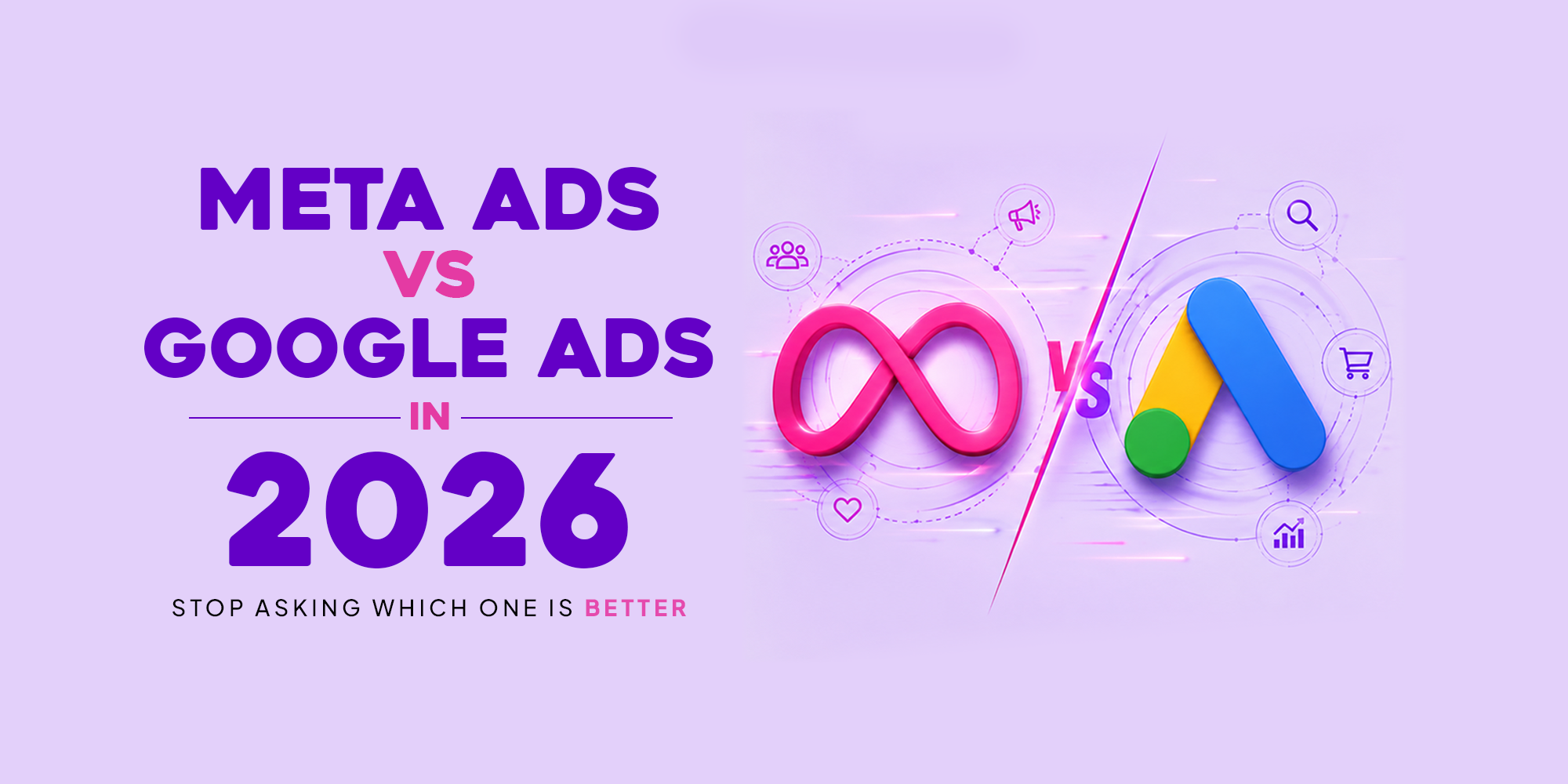
Every week, someone asks some version of the same question: should we be running Meta Ads or Google Ads?
It’s the wrong question. And the fact that it keeps getting asked by business owners, by marketing managers, by people who’ve been in digital for years tells you something important about how the industry has failed to communicate what these platforms actually do.
Here’s the right framing: Meta and Google are not competitors for your budget. They are different instruments that operate at different stages of the same buyer journey. Choosing between them is like asking whether a business should invest in sales or marketing. The premise doesn’t hold.
That said there are legitimate reasons to prioritise one over the other depending on your situation. Let’s get into it properly.
What These Platforms Are Actually Doing
Before comparing performance, you have to understand what each platform is fundamentally built for.
Google Ads captures demand. When someone types “emergency plumber near me” or “best project management software for agencies,” they have a need, they know they have a need, and they’re actively looking for a solution. Google puts your business in front of that intent. The purchase journey is short. The conversion rates are high. The cost per click is expensive because you’re paying for qualified, ready-to-act traffic.
Meta Ads create demand. When someone is scrolling Instagram, they are not looking for your product. They didn’t know they wanted it fifteen seconds ago. Meta’s job and your creative’s job is to interrupt that scroll, create desire, and begin a relationship. The purchase journey is longer. The conversion rates at the bottom of funnel are lower. But the scale of audience you can reach is enormous, and the cost of that reach is significantly cheaper.
Understanding this distinction changes everything about how you evaluate performance. Comparing your Google Ads ROAS to your Meta Ads ROAS is like comparing a closing call to a cold email. Different stages, different expectations, different metrics.
The 2026 Landscape Has Shifted and It Matters for This Decision
Something happened in 2026 that most businesses haven’t fully processed: for the first time in digital advertising history, Meta is projected to surpass Google in global net advertising revenue.
This is not a trivia point. It signals a fundamental shift in where marketers believe buyer attention lives and where the algorithm investment is going. Meta’s Andromeda system and Google’s AI Max for Search are both advancing rapidly, but the creative-first, social-first ecosystem is growing faster.
What this means for your strategy: the businesses that over-indexed on Google Search over the past decade built strong demand capture but weak demand creation. As AI Overviews pull more users away from clicking organic and paid results, and as zero-click searches eat into search traffic, the downside risk of a Google-only strategy is growing.
This doesn’t mean abandon Google. It means the case for running both has never been stronger.
When to Prioritise Google Ads
Google should be your first move or your heavier allocation when:
Your product solves a problem people are already searching for. If someone has a leaking roof, they search “emergency roof repair.” If someone needs an accountant, they search “accountant for small business.” If demand already exists and people are actively expressing it through search, Google captures that demand at the moment of highest intent. Starting with Meta in these situations means spending money to create awareness for something people are already looking for elsewhere.
Your sales cycle is short and transactional. E-commerce, local services, B2C products with clear category awareness, these categories tend to convert faster from search intent. The person found you because they wanted you. The friction is lower.
You have a limited budget and need immediate return. Google Ads, when set up correctly, can produce leads and sales within days. Meta typically requires a learning period and a longer attribution window. If you need to demonstrate return quickly, Google gives you more control over that timeline.
Your category has high search volume. If thousands of people are actively searching for what you sell every month, that’s a pool of qualified intent waiting to be captured. Not having a presence in search when that demand exists is leaving money on the table.
When to Prioritise Meta Ads
Meta should be your first move or your heavier allocation when:
Your product needs to be seen to be wanted. Fashion, home décor, food, beauty, fitness, lifestyle products, these categories thrive on visual discovery. People don’t search for a specific candle brand; they see it on Instagram and suddenly need it. If desire is created by seeing rather than searching, Meta is your primary platform.
You’re building a brand in a market that doesn’t know you yet. Google captures demand, it cannot create it. If you’re launching something new, entering a market where your category isn’t being actively searched, or trying to build brand recognition, Meta’s scale and targeting capability is the right tool for that job.
Your audience demographic skews younger. Search behaviour is more evenly distributed across demographics, but social media consumption is heavily weighted toward under-45s. If your buyer is 25–40, they’re spending significant time on Instagram and Facebook. Meet them there.
Your content is naturally visual or video-based. Meta in 2026 is, above all else, a creative platform. If you have strong visual assets, product photography, video content, testimonials, behind-the-scenes footage, you have the fuel Meta needs to perform. Without strong creative, the platform is difficult to make work.
The Strategy That Outperforms Both
The data on this is clear: businesses running both platforms in an integrated funnel consistently outperform those running either platform in isolation.
The reason is structural. Meta fills your funnel at the top. Google catches the people who are ready at the bottom. Without Meta, your Google Ads are only reaching people who already knew to search for you. Without Google, your Meta audiences who became interested but didn’t convert immediately have nowhere to land when they finally go looking.
The integrated approach looks like this: a cold audience sees your Meta ad. They don’t click but they register your brand. Later that week, they search for something related to what you offer. Your Google Search ad appears. They click, they convert. In Google’s attribution model, this looks like a Search win. In Meta’s model, it’s unattributed. In reality, both platforms contributed to that customer.
The businesses that understand this don’t cut Meta because “it doesn’t convert”, they understand that Meta’s job was never to close. It was to warm.
The Budget Question
If you’re starting from zero and have to choose, here’s the honest guidance:
Under $3,000/month — start with Google Search for service businesses with existing search demand. The intent capture is too valuable to ignore at limited budgets, and Meta’s learning period is harder to fund properly at this level.
$3,000–$8,000/month — run both. Allocate roughly 60% to Google and 40% to Meta if you’re a service business. Flip that ratio if you’re a product or e-commerce brand. The exact split matters less than the principle of feeding both ends of the funnel.
Over $8,000/month — if you’re not running both at meaningful budgets, you’re leaving scale on the table. At this level, the integration between platforms compounds returns in ways that single-channel investment simply cannot replicate.
The Question Behind the Question
When someone asks “Meta or Google?” what they’re usually really asking is: “Where will my money be safest?” And the honest answer is that safety in paid advertising comes from diversification, not from picking the right single channel.
The platforms are both evolving rapidly. Google’s AI Overviews are changing what it means to rank in search. Meta’s algorithm changes make creative quality more decisive than ever. Businesses that are over-dependent on either platform are exposed to changes they can’t control.
Running both with a clear understanding of what each is doing and why is not a hedge. It’s the strategy.
At Crown Digital, we build integrated Meta and Google Ads strategies that treat both platforms as parts of the same system, not competitors for the same budget. If you want to understand what the right allocation looks like for your specific business, book a call and start a conversation.