There’s a version of Google Ads advice that gets recycled endlessly: use the right keywords, write compelling ad copy, optimise your landing page. It’s not wrong. It’s just not enough anymore and in some cases, it’s actively misleading.
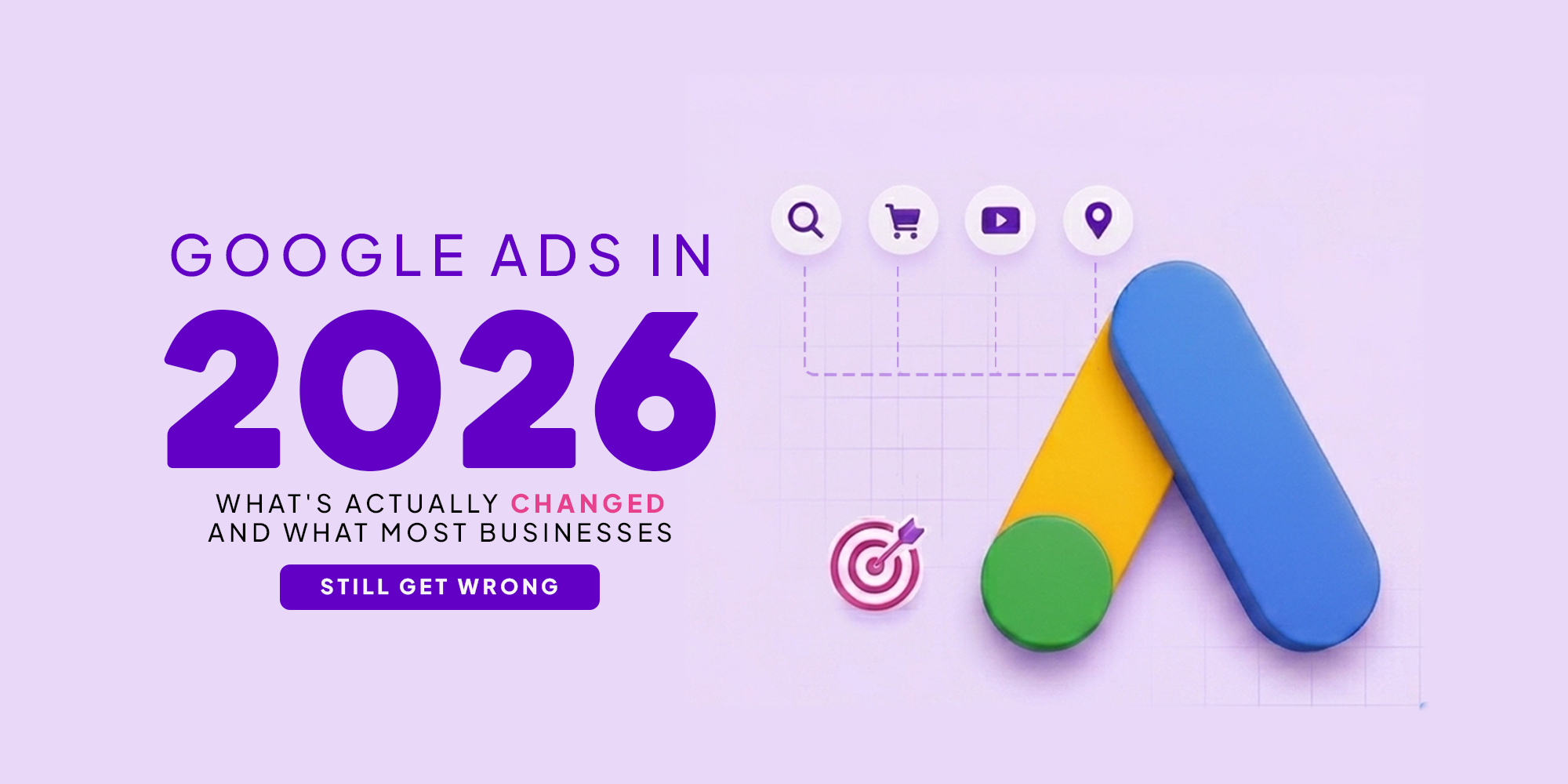
Google Ads in 2026 is a fundamentally different system than it was three years ago. The controls have changed. The match types behave differently. AI is making decisions that used to belong to the advertiser. And the businesses that are still managing their accounts the old way are paying more and getting less often without knowing why.
This is the version of the story that doesn’t get told enough.
The Platform Has Moved Toward AI Automation Whether You Like It or Not
Let’s start with the uncomfortable truth: Google has systematically reduced advertiser control over the past few years, and that trend accelerated sharply in 2025 and 2026.
Performance Max campaigns now run across Search, YouTube, Display, Discover, Gmail, and Maps from a single setup. Smart Bidding makes bid decisions in real time based on signals no human could process manually. Broad match keywords have expanded to match on intent rather than exact phrases meaning a search you’d never have targeted is now triggering your ads.
The instinct for many experienced advertisers is to resist this. To lock down campaigns, limit match types, avoid Performance Max, and maintain manual control wherever possible.
That instinct is understandable. It’s also becoming increasingly counterproductive.
The businesses winning with Google Ads in 2026 aren’t the ones fighting automation, they’re the ones learning how to direct it. That’s a meaningfully different skill set from traditional PPC management, and most businesses haven’t made the shift.
Why Keyword Strategy Still Matters, Just Not the Way You Think
Keyword research used to be about finding the exact phrases your customers type. You’d build tightly themed ad groups, match types would keep things controlled, and you’d add negative keywords to plug the leaks.
That model still has a place, but it’s been disrupted in two significant ways.
First, match types are no longer what they claim to be. Exact match in 2026 matches on “same meaning or same intent” which means “digital marketing services” can legitimately match to a query for “who runs Google ads for small businesses.” The name “exact match” is now a misnomer. Advertisers who don’t audit their search term reports regularly are funding searches they’d never have consciously chosen.
Second, Google’s AI increasingly interprets the intent behind a keyword rather than the keyword itself. This means keyword strategy is less about phrase selection and more about intent clustering, grouping keywords by what the searcher is actually trying to accomplish, and aligning your ad copy and landing page tightly to that intent.
The businesses that do this well aren’t necessarily running more keywords. They’re running fewer, better-organised campaigns where every element. keyword, ad, landing page tells a consistent story about one specific thing the searcher wants.
Performance Max: The Most Misunderstood Campaign Type in Google Ads
Performance Max campaigns are simultaneously the most powerful and the most dangerous thing Google has added to the platform.
Powerful because: when fed the right inputs, PMax can find conversion opportunities across Google’s entire inventory that no manually structured campaign would ever discover. It’s genuinely impressive when it works.
Dangerous because: when fed poor inputs, it spends your budget on low-quality placements and broad, irrelevant traffic and it gives you almost no transparency into where that money went.
The difference between PMax working and PMax burning budget almost always comes down to three things:
Asset quality. PMax assembles ads dynamically from the creative assets you provide, headlines, descriptions, images, videos. If those assets are generic, the system produces generic ads. If they’re specific, differentiated, and benefit-led, the system has something to work with.
Conversion signal quality. PMax optimises toward whatever conversion event you tell it to. If that event is “newsletter signup” when you actually care about “qualified demo request,” you’re training the algorithm on the wrong outcome. Get your conversion tracking right before you run PMax. Not after.
Audience signals. You can’t target with PMax the way you would a Search campaign, but you can provide audience signals, customer lists, remarketing audiences, similar segments that give the algorithm a head start. These signals don’t limit who sees your ads. They tell the system where to look first.
The Benchmarks You Should Actually Be Using
Here’s what 2026 Google Ads performance looks like across industries, so you have a realistic baseline:
1 . Average cost per click across Search: approximately $2.69
2 . Average conversion rate across Search: approximately 7%
3 . Average cost per acquisition: approximately $49
These are averages across all industries which means they’re nearly useless for any specific business. A conversion rate of 7% might be outstanding for a law firm and terrible for an e-commerce brand. A $49 CPA might be profitable for a software company and catastrophic for a local service business.
The benchmarks that actually matter are your own historical numbers compared to your unit economics. The question isn’t “is my CPA below the industry average?” It’s “is my CPA below my customer acquisition cost threshold, and is it trending in the right direction?”
Too many businesses optimise for platform metrics and ignore business metrics. Google doesn’t know your margins. You do.
The Tracking Problem Nobody Talks About Enough
Here’s a reality worth sitting with: a poorly configured Google Ads account with weak conversion tracking will underperform even when targeting excellent keywords. The algorithm’s ability to optimise depends entirely on the quality of the data you’re feeding it.
In 2026, good tracking means more than having a conversion pixel installed. It means:
Enhanced conversions — passing hashed first-party data (email addresses, phone numbers) back to Google so it can match conversions that happen off-platform, in cookieless environments, or across devices. Without enhanced conversions, you’re blind to a meaningful percentage of your actual results.
Offline conversion imports — if your sales process involves a phone call, a sales rep, or any step that happens outside your website, you need to be passing those offline conversions back to Google. Otherwise, you’re optimising for leads, not customers and those are not the same thing.
Attribution modelling — last-click attribution massively undervalues top-of-funnel keywords and overvalues bottom-funnel ones. Data-driven attribution, which Google now defaults to, gives a more accurate picture of which keywords are actually contributing to conversions throughout the journey.
Most businesses set up their tracking once, assume it’s working, and never check it again. Auditing your conversion setup every quarter is one of the highest-leverage activities in Google Ads management.
Search vs. Performance Max: How to Think About Running Both
The right answer for most businesses isn’t Search OR Performance Max. It’s both, with a clear division of purpose.
Search campaigns are your precision instrument. They capture high-intent queries from people who are actively looking for what you offer. They give you control, transparency, and the ability to optimise at a granular level. In a world where AI is taking over more and more, Search campaigns remain the clearest line between your strategy and your results.
Performance Max is your expansion instrument. Once your Search campaigns are profitable and your tracking is clean, PMax lets the algorithm find conversion opportunities you’d never have identified manually across YouTube, Display, Discover, and more. Think of it as amplification, not replacement.
The mistake is running PMax before Search is stable, or running PMax without proper asset quality and audience signals. Done in that order, with that foundation, it works. Reversed or skipped, it’s expensive guesswork.
What It Actually Takes to Run Google Ads Well
Honest assessment: Google Ads in 2026 rewards expertise more than it ever has. Not because it’s more complicated to set up, it’s actually simpler to launch than it used to be. But because the leverage points have shifted.
The difference between average and excellent Google Ads management now lives in: conversion tracking architecture, creative quality across formats, the ability to read AI-generated reports and know what they’re not telling you, and the strategic discipline to know when to override the algorithm and when to trust it.
These are not skills that come from reading a setup guide. They come from managing meaningful budgets across multiple industries and learning what the signals actually mean.
If you’re managing your own Google Ads and you haven’t audited your conversion tracking, your search term reports, and your PMax asset performance in the last 60 days, you have blind spots that are costing you money.
Crown Digital manages Google Ads for businesses that want performance, not just activity. If you’d like an honest assessment of what your account is actually doing and what it should be doing, Book a Free 30mins Initial Consultation Call.